
Too much cake
On Heartstopper and its lack of discontent

Alice Oseman posted the final pages of their webcomic Heartstopper on April 10, after launching in September 2016. 2000 pages of teenagers falling in love and developing their relationship all wrapped up.
I started reading Heartstopper fairly early on (before Nick and Charlie even got together). Since then, I’ve watched it become a massive phenomenon, getting a wildly popular Netflix live-action adaptation and prompting Oseman to rewrite the book that the webcomic was originally a spinoff of to tie into the comic better.
With the comic becoming insanely popular came the usual price of internet fame: fans and anti-fans, neither better than the other. The fans gloated about how pure and innocent and unproblematic their faves are (while simultaneously forcing one of the TV show’s leads to out himself) and the anti-fans complained about how only toothless fluffy Western BL can become successful in today’s media landscape and how more people need to read Asada Nemui and watch Kinnporsche. Both sides regularly drag out this comment the author made on Tapas in 2017 and as far as I know hasn’t addressed since:
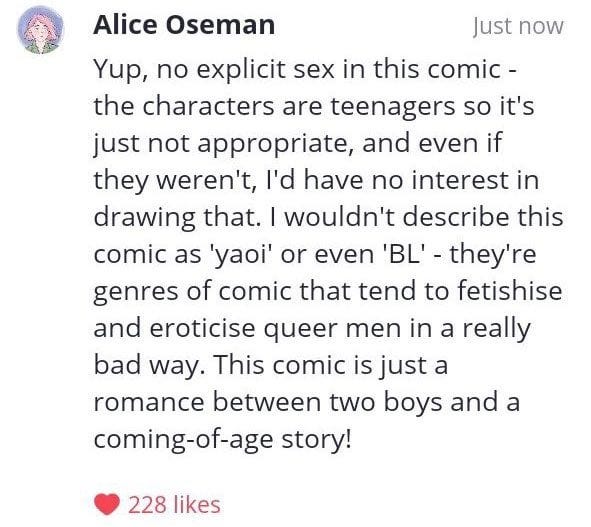
The characters did eventually start having sex (often), and fans vociferously complained and tried to cancel Oseman for it when they did, even though the sex scenes were not explicit, because implying teenagers have sex is just as bad for some people apparently.
But here’s the crazy thing: Heartstopper is simultaneously more and less fluffy than it seems to the outside observer. The early chapters especially had all the classic tropes of melodramatic school BL: bullying! Secret relationship! Homophobia! And later arcs would cover eating disorders and self-harm, extensively. The main character gets inpatient treatment at a psych facility! But somehow, even while having darker content on page than most BLs I’ve read, the overall impression from fans, haters, and the author themself is of a cozy-comfy happy story world where everything is okay. How is that possible?
At first I thought it was a quantity thing. 400 pages of Intensity obviously get drowned out by 1600 pages of cuddles and flowery effects. But that didn’t seem right. Wouldn’t the contrast make the intense parts stand out more?
Not exactly. Everything intense is carefully framed at a distance or quickly resolved. Charlie’s visit to the psych ward is told from Nick’s outside perspective and then recounted in Charlie’s journal as a past event. We never experience the worst of his mental health problems from his direct perspective, which softens the impact and allows the reader to focus on Nick soothing and comforting Charlie through his crises. When people are jerks, they get told off for it within a few updates. Everything smooths over to a mean of Nick and Charlie smiling at each other and (eventually) having tastefully implied sex.
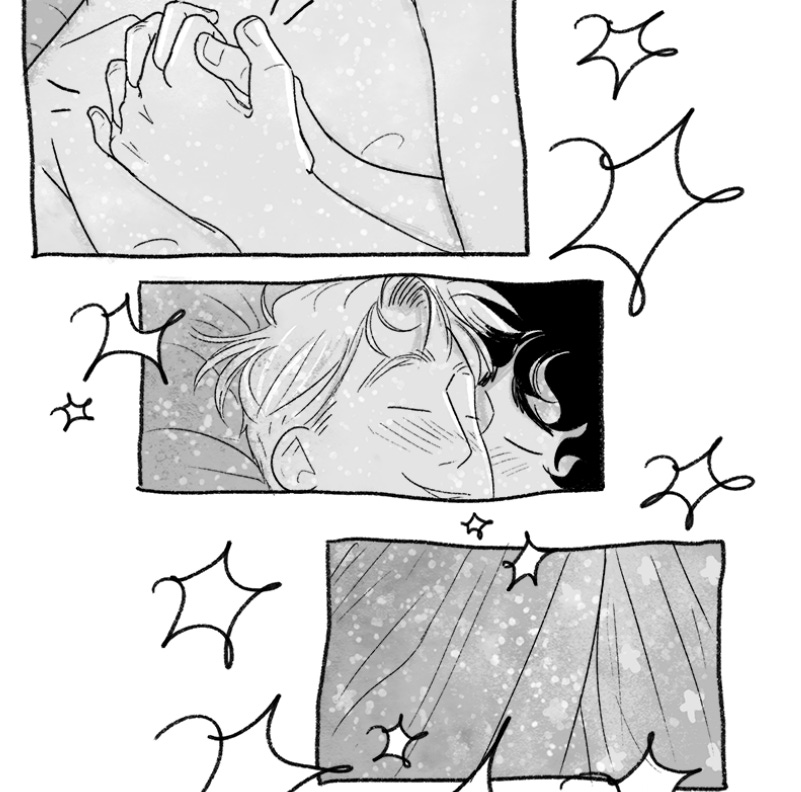
In the final arc, Charlie and Nick’s relationship is tested by the fact that Nick’s going to university in Leeds while Charlie still has a year of school left, but the tension isn’t… real. Kind of like Robby threatening to kill himself in the Pitt. We know he’s not gonna do it because his actor made the show, and we know Nick and Charlie won’t break up because this is a romance comic and that’s literally not allowed. Everyone in and outside of the story knows Nick and Charlie aren’t going to break up because they’re “Nick and Charlie”, their relationship is special and magical even as the other relationships around them are strained by end of school pressure.
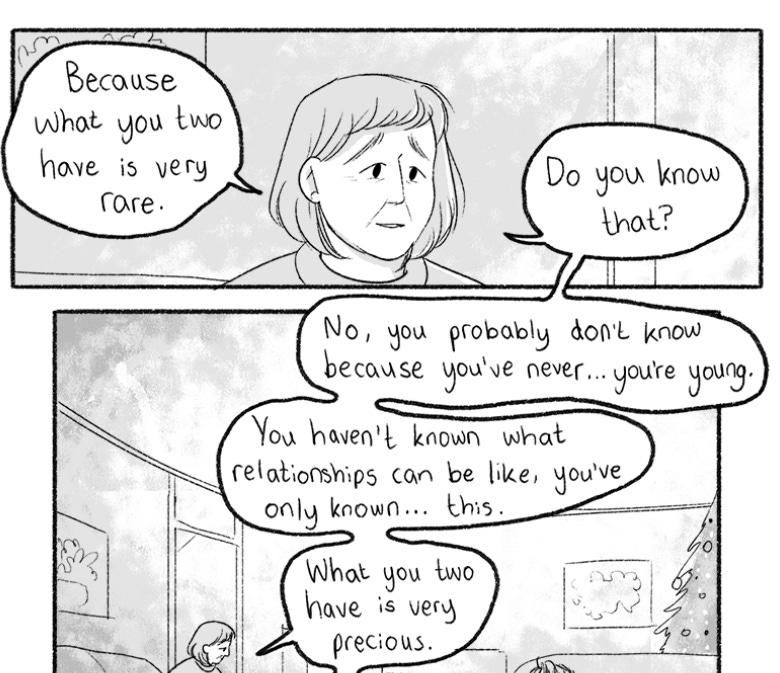
If either of them feel even a little doubt, it’s because they’re too in love. Nick is worried he doesn’t have anything going on besides Charlie and Charlie immediately reassures him about it. They can overcome anything and everything with the power of their love to the point that Nick is confused it doesn’t work that way for Elle and Tao, who decide to end their relationship rather than try long distance when Elle goes to college.
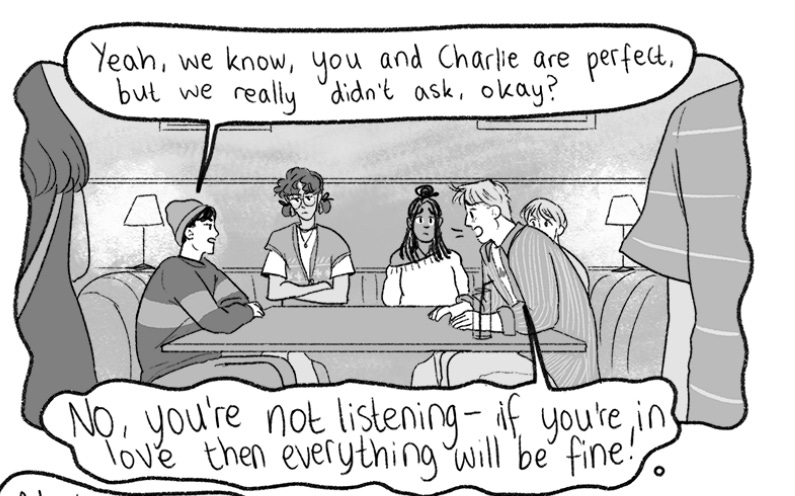
This overall sameness makes it a great comic to read serially, three updates a month, but difficult to binge as the perfection of their relationship gets kind of cloying. Too much cake.
So are the haters right? Is Heartstopper at fault for the downfall of queer media as a whole?
No, obviously not, it’s a fucking webcomic. It hasn’t even inspired any imitators I’m aware of. The school BL webtoons/webcomics I know all either started before/simultaneously to Heartstopper, or are explicitly inspired by the East Asian BL media Oseman denounced in 2017. For all of its popularity, the fact that it’s basically comfort food for everyone who consumes this comic means there’s not a whole lot of analysis or discussion being done about it. It’s not a comic that makes you think anything beyond “aw, cute!” because it refuses to linger on anything that might be upsetting to anybody.
Anyway, I thought it was fine, and now that it’s done I probably won’t think about it again.
Heartstopper is cute in some ways and eyerolling at others especially when every conflict is defeated with the power of love or the overcommunication final boss BUT it still had good topics it tackled in a barbie movie "babies first round of feminism" way so i get you 1000%